

A crystal ball, and a harder question
Earlier this year, I stood in front of an audience in Reykjavík, Iceland, and presented what we call Our Crystal Ball. This is our 2030 vision of case management when Agentic AI systems can read incoming documents, route cases automatically based on workload, and perform semantic searches across entire case registers.
In addition, Legal AI agents will be able to draft standard documents, conduct fact-checks against current regulatory frameworks and case law, and assist judges with the complex, almost mathematical reasoning behind findings and sentencing orders. Furthermore, predictive workload intelligence can warn court staff of emerging problems well before they arise.
The audience were energised. I clearly sensed that they wanted to learn more. Interestingly, the technology which I described is real today and not a story of fiction. However, a more difficult question is beginning to emerge, namely, how does any of this translate to the systems courts actually use today?
If you then combine this with what I am hearing from court administrators and justice officials across Europe: that the national case management platform they depend on was designed a decades ago the programme to replace it has over-run, or been restructured, or even quietly stalled.
As a result, front-line staff such as, the clerks, registrars and case officers, who do the actual work are bridging the gaps with spreadsheets, long email chains and their institutional memory. Meanwhile, case loads are increasing, the backlog grows, and as the maxim goes, "justice delayed is justice denied". I imagine, this sounds familiar?
The pattern that keeps repeating
Large-scale justice IT follows a well-documented cycle. A bespoke system is commissioned to replace everything at once. It takes years to specify, years to build, and by the time of the launch date, the operational reality has moved on. To further complicate the situation, configuration becomes a bottleneck, maintenance costs balloon and because the entire estate depends on a single platform, every change is politically and technically expensive.
Analysis gathered from the both the corrections and offender management segments of the criminal justice system, paint a stark picture. Their ageing bespoke systems are not just expensive to maintain, they actively encode yesterday’s practices into today’s operations. The same dynamics play out in courts. An important question which many people are asking is "When did your current case management system last change the way someone actually works?’"
And the uncomfortable truth which most people in the sector already know is that the next national replacement programme is not arriving soon. Even where programmes exist on paper, they rarely reach front-line practitioners within the timescale that operational pressures demand.
So, the question becomes: what do you do in the meantime?
Drop-in improvements: a different logic
This is the idea behind what we’ve started calling ‘drop-in improvements’. This is the thesis behind this article and the position Casedoc will present in June at Modernising Criminal Justice.
The logic is simple. Instead of waiting for a monolithic replacement, identify the specific sub-processes where time is lost, errors compound and practitioners are working around the system. Then modernise that one workflow with a bounded, deployable tool that integrates with the national core but doesn’t depend on it changing.
We call this ‘micro-modernisation’. The scope is small, the deployment is fast and importantly, outcomes are measurable. And if it doesn’t work, you haven’t destabilised your estate.
Think about the processes in your own organisation. Which ones are costing you the most time, the most re-work and the most frustration. Importantly, could they be isolated enough to fix without touching everything else?
Why COTS is no longer a compromise
Commercial off-the-shelf software (COTS) in justice was once seen as too generic for specialised legal processes. That argument has weakened considerably. Today’s COTS justice platforms are configurable to local legal contexts, updated more frequently than bespoke builds, and significantly cheaper to maintain. Expert analysis across the corrections and justice sector now explicitly recommends configurable COTS platforms over bespoke systems. This is not a fallback position but our preferred strategic choice. The shift is important. COTS is no longer generic. It is domain-specific and configurable. A well-designed court case management system can support the procedural rules, document templates and workflow patterns of a specific jurisdiction without requiring custom development for every rule change. That is exactly what a ‘drop-in’ improvement needs to be, namely, specific enough to solve a real problem, standard enough to deploy and maintain effectively and efficiently.
What it looks like when you add legal intelligence
‘Drop-in’ improvements become substantially more powerful when you combine case management with domain-specific ‘legaltech’. This is not a chatbot bolted onto a legacy system, but process expertise paired with legal intelligence at the point where work actually happens.
At Casedoc, we’ve been building this through our collaboration with partners like Lagaviti, a legal AI assistant grounded in statute, legislative history and methodology-aware reasoning. Together, COTS case management plus COTS legaltech creates something genuinely new: a tool that manages the process and understands the law.
Here’s what that looks like in practice. Below is a view from our Casedoc Court Case Management environment, which is a single criminal court sub-process, prosecution disclosure, managed end-to-end
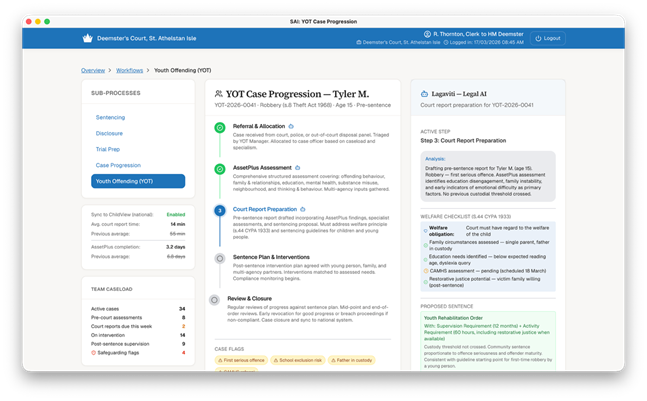
Screenshot: Casedoc CMS – All data fictional and only for demonstration purposes.
What you’re seeing:
On the left, a sidebar listing the sub-processes for this case i.e. Youth Offending (YOT), a 14-person team that sits entirely outside the court's core systems. Below it, the statistic that matters, the average court report time down from 55 minutes to 14.
In the centre, Tyler M.'s case, a 15-year-old referred for robbery, currently at step three: court report preparation. Five steps from referral to review and closure, with case flags for school exclusion and a parent in custody.
On the right, Lagaviti's welfare checklist which is citing section 44 of the Children and Young Persons Act 1933, the Sentencing Children and Young People guideline, and the UN Convention on the Rights of the Child. A proposed Youth Rehabilitation Order with activity, supervision, and curfew requirements, generated from the same structured reasoning as the Crown Court workflows, but applied to a team that would never normally get access to this kind of tooling.
That is the point. The YOT (a demonstration only, name) didn't need a new national system. It needed a bounded, deployable tool that understood its workflow.
Now imagine applying this approach to your most time-consuming court process.
What comes next
This is the first of three articles leading up to Modernising Criminal Justice in June 2026:
- March (this article): Why ‘micro-modernisation’ is the realistic path, and what drop-in improvements look like.
- April: Where Case Management Meets Legaltech: How COTS CMS and domain-specific AI work together. Interoperability, integration, and the partnership model.
- May: The Buyer’s Guide to Drop-in Improvements: Which sub-processes are ripe for modernisation, and what to ask vendors before you commit.
The crystal ball is still bright
The vision I presented in Iceland namely, agentic case management, predictive analytics and semantic search are real, and are coming. But the path there does not start with replacing your national system. It starts with one process, modernised with today's tools, delivering measurable results within weeks.
Because these are configurable COTS solutions rather than bespoke builds, you avoid locking yourself into a rigid path. When a wider system overhaul is required, a standards‑based, interoperable tool supports that transition rather than hindering it. No vendor lock‑in. No procurement delays. Just a sub‑process that already performs.
The crystal ball isn't cracking because the future is less bright. It's cracking because we've been trying to see everything through one lens. Drop-in improvements are smaller, sharper lenses - each focused on the process that matters most right now.
The question is: which one does your organisation need first?
.png?width=1200&height=500&name=MJIT%20-%20Blog%20CTAs%20(12).png)
Casedoc builds court-specific case management software, a configurable COTS solutions designed to sit alongside national systems. Bjarni Sv. Gudmundsson speaks at Modernising Criminal Justice, 9th June 2026. If you have a process you’d like to talk through, we’re always interested in hearing what the real bottlenecks look like: bjarni@casedoc.com

Bjarni Sv. Gudmundsson, Casedoc