

Public services are connected by people every day.
Housing teams, highways teams, estates teams, compliance teams, environmental teams, contractors and frontline workers all contribute to the same overall purpose: keeping services safe, reliable and accountable.
But the systems they rely on are often far less connected.
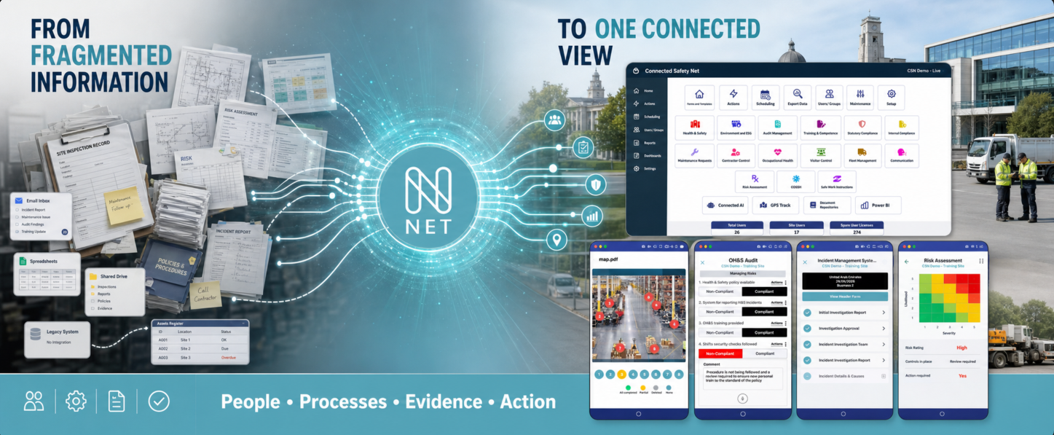
Across the public sector, critical information still lives in paper forms, spreadsheets, drawings, inboxes, shared drives, standalone systems and local working practices. Each one may serve a purpose. Each one may have grown from a real operational need. But together, they can create a fragmented picture of what is actually happening across an organisation.
That fragmentation matters.
It affects how quickly teams can act, how confidently leaders can make decisions and how clearly organisations can evidence compliance, risk and performance.
The problem is not always a lack of data
Public-sector organisations are not short of information.
Every inspection creates data. Every asset has history. Every contractor produces documentation. Every incident generates evidence. Every service area has operational knowledge built up over years of delivery.
The challenge is that this information does not always work together.
When data is spread across disconnected processes, it becomes harder to see the full picture. Teams may know their own area well, but leaders may struggle to understand how risks, actions and responsibilities connect across the organisation.
This can lead to duplication, delays and unnecessary administration.
People spend time searching for information, re-entering the same details or producing reports manually. Frontline teams carry the burden of process, while managers and senior leaders are left trying to piece together evidence from multiple places.
In a public-service environment, where accountability is high and resources are under pressure, that is not sustainable.
Connection changes the way organisations work
Connected operations are not about replacing every system overnight.
They are about joining up the processes that matter most.
For many organisations, the best place to begin is one high-value operational challenge. This could be inspections, risk assessments, contractor assurance, corrective actions, estates checks, environmental reporting or another process where delay, duplication or poor visibility creates pressure.
By digitising that process in a way that reflects how teams already work, organisations can begin to create live evidence, clearer accountability and faster action.
The value comes not just from removing paper or spreadsheets, but from connecting people, processes, evidence and decisions.
When information is connected, risk becomes visible earlier. Actions can be tracked more clearly. Leaders can see what is happening across locations, services and teams. Frontline workers can spend less time on administration and more time delivering the services communities rely on.
Transformation does not need to start big
One of the biggest misconceptions about transformation is that it has to begin with a large, complex programme.
In reality, some of the most effective transformation starts with a focused operational problem.
Start with one pressing challenge. Understand the process. Digitise it properly. Prove the value. Then build from that foundation.
This approach is practical because it respects the reality of public-sector operations. It does not ask teams to abandon trusted working knowledge. It does not treat transformation as a one-off project. It allows organisations to improve step by step, while building confidence and measurable value along the way.
From disconnected processes to connected intelligence
The future of public services will not be shaped by more data alone.
It will be shaped by the ability to connect information, understand what it means and act on it with confidence.
Connected operations create the foundation for connected intelligence. They allow organisations to move from fragmented administration to clearer visibility, stronger accountability and better decision-making.
For public-sector leaders, the question is no longer simply whether processes should be digitised.
The more important question is:
Are those processes connected in a way that helps people act, evidence progress and improve outcomes?
Because when public services connect the processes that matter, transformation becomes practical, measurable and achievable.


Paul Richardson
Group MD of Connected Safety Net. Connected Safety Net helps organisations turn disconnected processes into connected intelligence, supporting public-sector teams to begin with one high-value process and build towards a connected operational ecosystem.
.png?width=80&height=80&name=DigiGov%20300px%20Square%20(1).png)