

The problem isn't the staff. It's what they spend their time on
More staff working in the same way isn't closing gaps in public services. Across the UK, headcount has grown while waits have got longer: NHS Scotland has 14% more staff than in 2019, yet 5% fewer outpatient appointments are being delivered and 8% more patients are waiting over a year. Social Security Scotland has seen calls where claimants waited over an hour, and 17% of applications sitting unresolved for 40 days or more.
AI is already being pointed at this problem. Across government, health, education and local services, teams are using it to draft, summarise, search, classify and respond faster than before. Whilst that has value, it hasn't closed those gaps, and it won't, if all it does is help people do the same work slightly quicker.
The output is faster. The work has not really changed. That is the strategic fork now facing public sector leaders: should AI simply assist the existing way of working, or should it help change how work happens in the first place?
The productivity trap
The first wave of AI adoption focused on individual productivity, and understandably so. Assistants embedded into existing applications didn't require procurements, service redesign, deep integration, or any change to how citizens interact with public services. That made them the safest place to start. Whilst it has increased skills and confidence, it was turnkey... never addressing the systemic constraints within organisations.
Take our Victim Journey work with policing: before any AI was involved, the real issue wasn't that call handlers were slow or unable to answer "where's my case?" — it was that there was no way for a victim to get that answer without calling at all. An AI assistant that helped a handler answer faster would have made the call shorter. It would not have stopped the call needing to happen 400,000 times a year.
That's the trap. Productivity AI reduces friction for the individual, but if the underlying workflow stays the same, the gains stay trapped at the level of the individual worker. The organisation becomes a little more efficient. It does not become different — and every one of those unnecessary calls still costs money to handle, whether a human or an AI-assisted human is handling it.
Humans became the middleware
In many organisations, the real constraint isn't that staff are working less or working slower, it's that complexity and demands have increased, staff have become the integration layer between systems, teams and processes. They copy information between applications, chase approvals, send reminders, interpret guidance, route cases, and stand up meetings to force work through a process that doesn't otherwise move.
This isn't a failure of people. It's what happens when operating models rely on humans to make fragmented systems work. Did Skippers lose their jobs when sonar and GPS arrived? No, the sensing work moved to the machine, and the skipper operated at a higher level, making the calls that actually needed judgement. That's the shift public sector leaders should be aiming for: not better-equipped middleware, but no middleware role to fill in the first place.
Left unaddressed, this is also where shadow AI creeps in. If staff are stuck being the connective tissue between systems that don't talk to each other, they'll quietly find their own tools and workarounds to cope... with no oversight, no guardrails, and no visibility for the organisation. That's a governance risk hiding inside what looks like a productivity gap.
Assistants and agents solve different problems
AI assistants help people complete individual tasks: draft, summarise, search, compare, explain. They earn their place where work genuinely requires human judgement but could be made easier or faster.
AI agents help work move. But "work" happens in more than one place, and the agent that helps depends on where the constraint sits.
Some agents sit in the citizen journey: using approved knowledge, following rules, taking defined actions, updating a case, escalating to a human when judgement is required. This is Bobbi's world, the public-facing front door.
Other agents sit inside the organisation, working alongside staff rather than the public. These are multiplayer agents, coordinating across systems, teams and tools that were never designed to talk to each other: pulling context into a shared workspace, triggering the next step in a process, looping in the right people rather than making one person chase them down. This is where a lot of the "human as middleware" work actually gets removed, not automated around.
If the problem is cognitive load, even an AI assistant may not help, as you’re relying on the individual again to speed up their work… If the problem is that work is stuck between systems, teams or approvals (whether that's a citizen's case or an internal process), you need an agentic workflow, and the right one depends on who's stuck: the public, or your own staff.
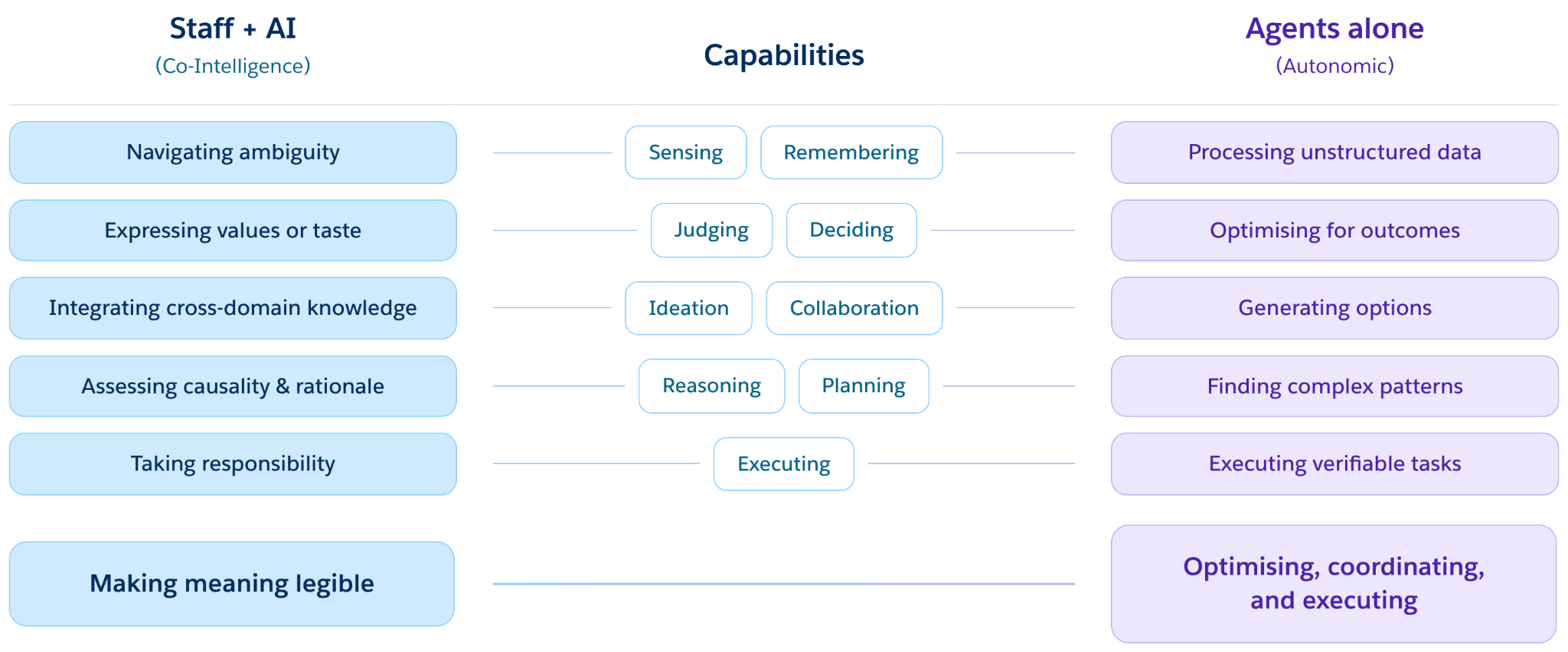
The question isn't "where can we put AI?" It's "what constraint are we trying to remove, who's experiencing it, and does removing it need a smarter assistant or a moving agent?"
Start with the service problem, not the pilot
This is where I'd push back on how most public sector AI pilots are run. You can pilot a technology or feature. You cannot meaningfully pilot service transformation — it's too narrow a test, running for too short a time, against criteria that were never designed to prove whether a service actually changed.
The Thames Valley Police and Hampshire & Isle of Wight Constabulary work is the counter-example. It didn't start with an agent; It started with the Victim Journey problem above, and the first fix was pure transparency: giving victims a secure way to track cases and message officers. That alone cut call volumes by 10%, avoided £1.4m in cost, and cut cost per interaction by 97%. Agent Bobbi was the next logical step, not the first one... a digital front door built on top of a service that had already been redesigned, with guardrails and escalation to humans for high-risk cases. It now handles roughly 200 conversations a day, and on VAWG-related queries specifically, it's identifying and routing around two cases a day to human support — cases that might otherwise not have surfaced at all.
That's the model for a pilot that scales rather than stalling: start with the service problem, prove the redesign, then layer in the agent — not the other way round.
Internal services matter too
The same principle applies inside organisations. NHS Shared Business Services processes £395bn of NHS funding a year. The shift that mattered wasn't introducing AI — it was redesigning how staff and suppliers raise, track and resolve queries. The result: 84% of queries now start through the digital help centre, handling times down 20%, and the time to raise a query down from 12 minutes to three.
AI can help an individual respond faster, or it can change how work moves through the organisation. Both have their place, but they are not the same thing, and it's worth being honest with yourself about which one you're actually doing.
Why pilots stall
Pilots aren't the problem — testing and managing risk carefully is exactly right. The problem is pilots designed with no route to service change: demo-led rather than service-led, dependent on a champion who moves on, measured on adoption rather than impact.
And sometimes the hardest part is human. Staff concerns about job security and professional judgement aren't abstract, they shape behaviour. Introduce AI without clarity on roles and accountability, and staff will either resist it or quietly work around it. Leaders need to involve staff in redesigning the workflow itself, not just in adopting the tool at the end of it.
The practical test
Before approving another pilot, turning on a new feature, or applying your AI assistant to a task, ask three questions:
- Is this helping someone complete an existing task faster, or removing the constraint that made the task exist?
- Where is a person still doing the work of two systems that should talk to each other?
- What measurable outcome would prove the service has genuinely changed — not just that people are using the tool?
The real test of AI in the public sector isn't how fast we can do the work we already have. It's whether leaders are willing to redesign the work itself — the way sonar and GPS didn't make skippers faster fishermen; they made the sensing work disappear, so the skipper could spend their judgement where it mattered.
That is the strategic fork.
If you'd like to explore these ideas in more detail, we've recently published the second edition of the AI Agents Handbook: Redesigning Public Services for the Age of AI. It looks at how to identify high-impact opportunities for AI agents, avoid common pilot traps, and build a practical path from experimentation to public service transformation. You can download your copy here.
We'll also be joining DigiGov Expo on 23–24 September at ExCeL London, where we'll be hosting a session in the GovTech Theatre on how public sector organisations can move beyond AI pilots and use AI to drive meaningful service transformation. We look forward to seeing you there and continuing the conversation in person.


Chris Pannell, VP of AI, Data & Communication Platforms, Salesforce
.png?width=80&height=80&name=DigiGov%20300px%20Square%20(1).png)