

While public sector leaders are under operational pressure to deploy AI to find efficiencies and relieve budgetary pressures, a brutal technical reality remains: advanced tools are only ever as good as the data they consume. Implementing automation on top of poor data won’t fix your back-office bottlenecks - it will just get you to the wrong decision, faster.
James Blake, CEO of binary10, looks at the challenges and opportunities for AI in the public sector
Across the public sector, the mandate is clear:
- Find immediate operational efficiencies
- Streamline frontline delivery
- Relieve the intense pressure on the public purse.
Whitehall’s heavy push toward artificial intelligence (AI) is not driven by a simple desire for new technology; it is a financial necessity designed to unlock a massive productivity dividend. Leaders are under immense pressure to deploy automated systems to clear administrative backlogs and improve outcomes for society.
But a brutal technical reality is stalling these ambitions before they even get the chance to take off... AI is only as good as the data it consumes.
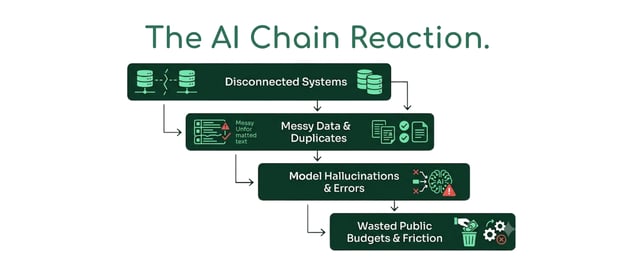
The common phrase "rubbish in, rubbish out" (and its slightly more sweary cousin!) has never been more accurate. If an advanced machine learning model is fed fragmented and unvalidated data, it will not optimise public services, it will simply automate errors at a bigger scale. Rather than delivering on the efficiency promise, this will lead to model hallucinations, compliance risks and wasted budget.
The truth is poor data quality is a killer of public sector AI initiatives.
To bridge the gap between public sector ambition and operational reality, leadership teams need to ask a foundational question: Where does our infrastructure actually sit on the data maturity scale?
Diagnosing the Readiness Gap
You do not need to look at a complex technical diagram to understand your data maturity. While our experience tells us that a few parts of the public sector are more advanced, on the ground, we know that data environments generally fall into two categories:
- The Reactive Firefighter (Level 1 Data Maturity): Data is managed entirely on a "fix it when it breaks" basis. Information is trapped in disconnected legacy systems, duplicate records run rampant, and internal teams spend more time reconciling versions of the truth than improving services.
- The Scheduled Illusion (Level 2 Data Maturity): Clean-ups and data audits happen periodically, perhaps annually or during a major system migration.
Both are problematic for rolling out AI across an organisation because the data begins decaying the day the audit ends. This means that automated systems are constantly fed lagging data and the further away from the audit you are, the worse the data is likely to be.
If either of these scenarios sounds familiar to your organisation, your infrastructure is not ready for AI yet. Deploying a copilot or automated workflow on top of these foundations will simply amplify, speed up, and scale your existing back-office problems.
Dismantling the "Legacy Trap"
When faced with this reality, many data leaders hit a wall of analysis paralysis. It is easy to assume that to achieve "AI readiness," an organisation must launch a decade-long, high-risk project to completely replace its legacy software.
The good news is you do not need to eliminate your legacy systems to start leveraging AI.
The idea that old systems completely block innovation is a myth. Data quality can and should be addressed directly on top of your existing legacy infrastructure.
Alternatively, public bodies can solve the legacy bottleneck by extracting information into a centralised data or LLM warehouse layer. This creates a secure, authoritative repository to train and feed corporate AI engines without requiring a multi-million-pound lift and shift software migration.
The issue isn't the age of the system; it's the lack of continuous validation tools keeping the records inside it clean.
Realities from the field:
This data deficit isn't an abstract theory; it is an operational reality documented by data practitioners on the frontline. In a recent 2026 sector study mapping infrastructure readiness, data professionals consistently rated their internal data quality as just "middle of the scale", adequate for day-to-day work, but completely unreliable for advanced automation.
As one public sector IT professional noted:
"People think they know their data and where it lives but the reality is, they really don't. That's our biggest challenge."
Another practitioner summarised the baseline dilemma perfectly: "It is that age-old problem of too many systems and not enough quality data... It's all over the place."
With findings from this report ringing in our ears, I recorded a podcast with my co-founder to discuss how Local Authorities can tackle this problem. I know not everyone at DigiGov will be a local authority, but a lot of the key takeaways are relevant across the Public Sector.

I’ll be at DigiGov Expo 2026 with some of my binary10 colleagues at stand TS11 and I’d love to discuss how your organisation is tackling this data issue.
At binary10, we help large public sector organisations transition away from fragile legacy infrastructure and build the modern data architectures required for safe, scalable AI. We are here to help you make data-driven decisions that you can trust!
Everyone has a different approach, and we love exploring where your organisation is and what steps you’re taking over the coming years to change that.
Benchmark your authority: We need your help
As part of our work in the Public Sector, we want to take the pulse of the sector and see if what we find working with clients is the same across organisations. If you have 60 seconds, we have a survey we’d love you to complete which will give us data on exactly where the sector’s infrastructure and data maturity is.
We want to hear about the specific system bottlenecks and data-sharing realities your department handles every day. Your anonymous insights will directly shape our upcoming executive report, which we’ll launch at DigiGov Expo 2026. And if you complete the survey, you’ll receive a copy of the report and win a special prize!
[Click here to complete the 60-second public sector flash survey]
See you in September – don't forget we’re at TS11... look out for the plants!


James Blake, CEO at binary10