

Artificial intelligence is now part of almost every conversation about the future of public services.
It promises faster analysis, better insight, improved efficiency and new ways to support decision-making.
But there is an important question that should come before any discussion about AI:
What information is AI being asked to work with?
Because artificial intelligence is only as useful as the operational foundations beneath it.
If information is fragmented, incomplete or disconnected, AI may make that fragmentation faster. It may summarise poor-quality information. It may surface patterns from inconsistent evidence. It may create confidence where the underlying data is not yet connected enough to support it.
That is why public services need to think not only about artificial intelligence, but about connected intelligence.
AI needs connected information
Across public-sector organisations, operational information is often spread across different teams, systems, locations and formats.
Some of it sits in paper records. Some in spreadsheets. Some in drawings. Some in asset systems, contractor portals, inboxes or local folders. Some is known by experienced people but not easily visible to the wider organisation.
This creates a challenge.
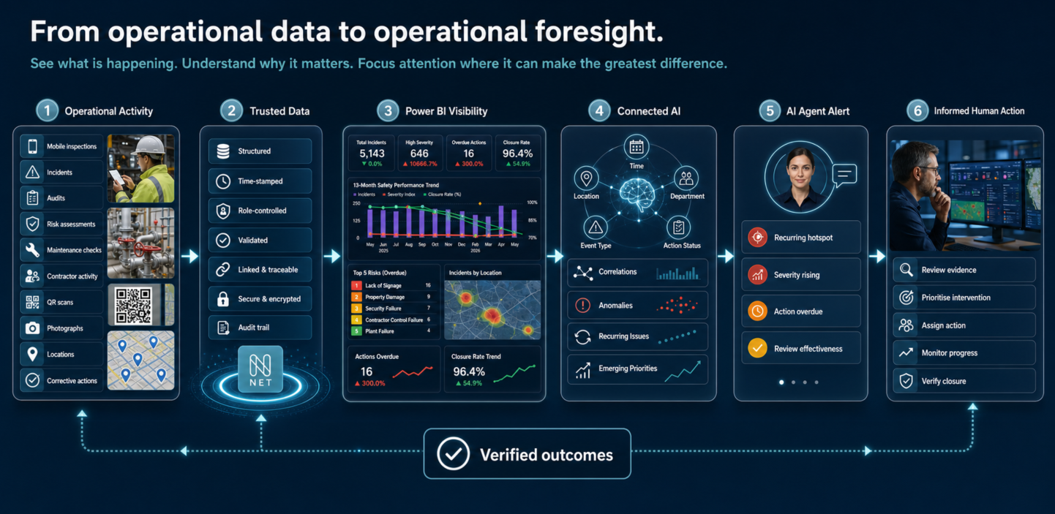
AI can support decision-making, but it cannot automatically fix disconnected operations. Before organisations can use AI confidently, they need a clearer view of the processes, evidence and actions that sit underneath daily service delivery.
Connected intelligence starts by bringing those elements together.
People. Processes. Evidence. Actions. Insight.
When these are connected, organisations can begin to understand not just what has happened, but what needs attention, where risk is emerging and where resources may be needed most.
Intelligence is not just reporting
Many organisations already produce reports.
The issue is how much effort it takes to produce them, and whether they reflect what is happening now.
When information is gathered manually from multiple sources, reporting can become a backward-looking activity. Teams spend time collecting updates, checking spreadsheets and chasing evidence. By the time the report is complete, some of the information may already have changed.
Connected intelligence is different.
It is built from live operational activity. Inspections, actions, evidence, risk assessments, contractor updates and assurance tasks become part of a connected picture.
This gives leaders a clearer view of operational performance and helps teams act earlier.
The aim is not simply to have more dashboards. It is to create a stronger connection between frontline activity and leadership decision-making.
Human judgement still matters
In public services, decisions carry responsibility.
They affect homes, roads, buildings, schools, employees, contractors, communities and the public. That means intelligence must support human judgement, not replace it.
AI and analytics can help identify patterns, highlight exceptions, summarise information and support prioritisation. But people still need to understand context, make decisions and take responsibility for action.
This is particularly important in areas such as safety, compliance, estates, environment and workforce operations, where evidence and accountability matter.
Connected intelligence should help leaders ask better questions.
Where are risks increasing? Which actions are overdue? Which sites need attention? Which processes create the most duplication? Which teams need support? Where could earlier intervention prevent larger issues?
These are practical questions. They are also transformation questions.
Building the foundation for future services
The public sector does not need to wait for a perfect future state before improving how intelligence is used.
It can begin with the operational processes that already create value and pressure today.
A single inspection process. A contractor assurance workflow. A corrective action process. An environmental monitoring activity. A fleet or estates check.
When these processes are digitised and connected properly, they begin to create structured operational evidence. That evidence can then support better reporting, clearer accountability and more confident decision-making.
Over time, it also creates the foundation for more advanced intelligence.
AI becomes more useful when it is working from connected information. Leaders gain more confidence when evidence is current and traceable. Frontline teams benefit when insight leads to practical action, not just another report.
The future is connected
The future of public services will not be defined by technology alone.
It will be defined by how well organisations connect people, processes, information and intelligence to improve outcomes.
Artificial intelligence may play an important role in that future, but connected intelligence is the foundation that makes it meaningful.
For public sector organisations, the opportunity is clear.
Start with the processes that matter. Connect the evidence. Make action visible. Build intelligence from the reality of daily operations.
That is how transformation becomes practical.
And that is how public services can move from disconnected information to connected intelligence.


Paul Richardson
Group MD of Connected Safety Net. Connected Safety Net helps organisations turn disconnected processes into connected intelligence, supporting public-sector teams to begin with one high-value process and build towards a connected operational ecosystem.
.png?width=80&height=80&name=DigiGov%20300px%20Square%20(1).png)