
Speaking at the Modernising Criminal Justice conference, Milan Bollegala and Richard Meffen of the Police Digital Service (PDS) set out two pieces of work underpinning national policing's digital ambitions: a refreshed National Police Digital Strategy, and a major baselining exercise for digital forensics capability across every force in England and Wales.
Milan opened with an overview of PDS itself - funded by the Home Office to coordinate and manage digital services on behalf of UK policing. The National Police Digital Strategy, first developed in 2020, was refreshed in 2024-25 to extend its horizon to 2030, built around five foundational ambitions with public protection at the top, supported by seven delivery "enablers." Milan ran through progress against each: a national data analytics office and completed data maturity assessments across all forces; a nationally assured cloud hosting environment on Microsoft Azure, designed specifically for policing rather than relying on locally hosted systems; national blueprints for how IT programmes should be resourced; a national platform for Microsoft Copilot deployment; and a "Digital Change and Insight" tool that flags where individual forces risk falling behind national programme timescales, allowing senior stakeholders to intervene early. Work is also underway on a standard job role framework across the roughly 600 distinct IT roles that exist across policing, and a strategic supplier performance framework intended to create a more competitive, standards-assured marketplace for policing technology.
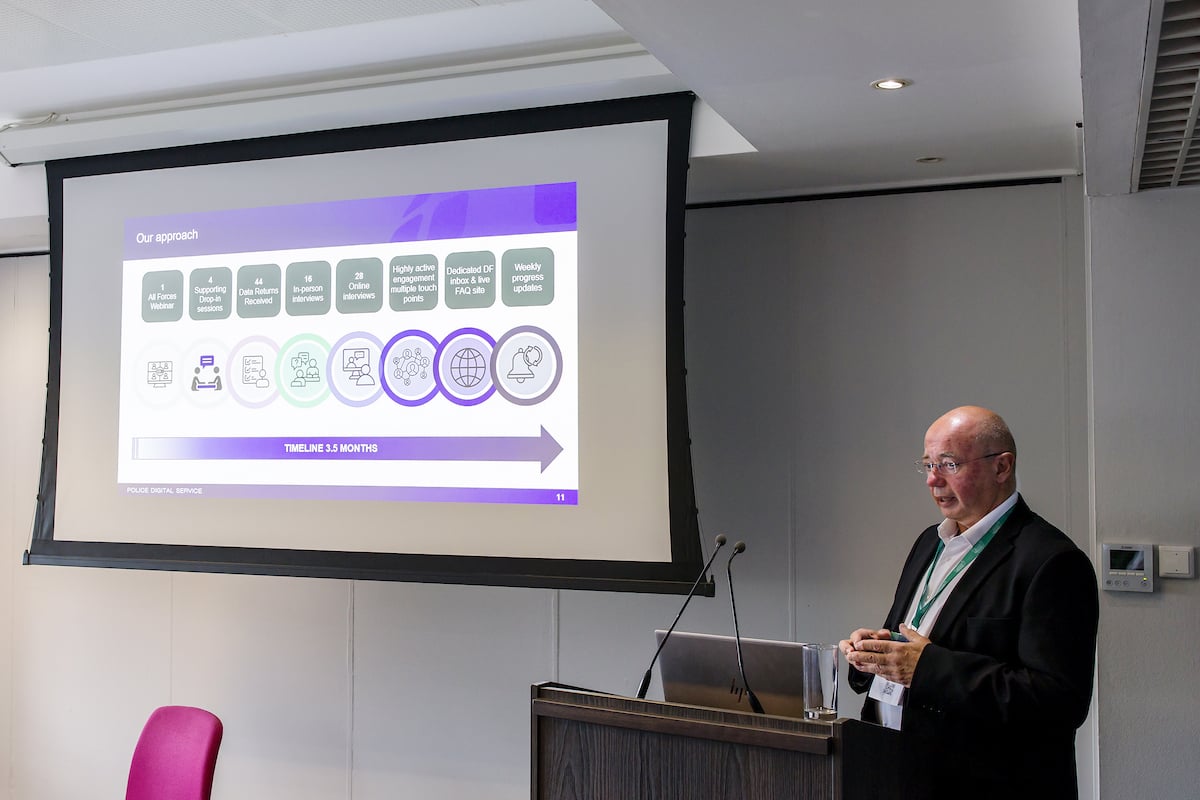
Richard then set out a specific national programme: baselining digital forensics infrastructure across all 43 forces, commissioned by the Forensic Reform programme. He was candid that this was different from previous efforts, which had often started projects without first understanding the actual state of play, or spent time "polishing the problem" rather than addressing it. Given just three and a half months - starting just before Christmas - PDS combined a simplified questionnaire with direct interviews, 16 of them face-to-face and 28 online, reducing average interview time from three hours to 45 minutes as common patterns emerged across forces. Weekly progress updates, visualised as an engagement heat map, helped build stakeholder confidence throughout. Against a target of 75% force engagement for the work to be considered viable, PDS achieved 100%, producing a 100-page baseline document covering pain points, maturity levels, business requirements, technology landscape and risk across all 43 forces - revealing, among other things, that IT maturity varies considerably and that forces are running effectively 43 different technology stacks and roadmaps for digital forensics. Richard was clear that ownership of the findings and next steps now sits with Forensic Reform, not PDS, and stressed that this kind of baselining should be a standard first step before any transformation programme, not an afterthought.
Milan closed by addressing interoperability - a policing priority since at least 1990, he noted, and now reframed by the government's reform white paper as a critical structural enabler rather than an aspiration. A recent survey identified interoperability as one of the biggest barriers to digital business change. With support from techUK and the Joint Emergency Services Interoperability Programme, PDS has developed an interoperability handbook and maturity assessment framework built around four layers: foundational (basic system connectivity), structural (consistent, standards-based data formats), semantic (shared vocabularies and data dictionaries), and organisational (aligned policies and data-sharing agreements both within policing and with external partners). Milan framed this as the necessary groundwork for the shift from 43 fragmented forces toward a more coherent national policing model - work that has to happen locally and regionally before it can scale to national and cross-agency data sharing.
The Takeaway
Both strands of this session point to the same underlying discipline: understand the actual state of your infrastructure and capability before designing the next transformation programme. For leaders sponsoring digital change elsewhere in the system, PDS's forensics baseline is a practical demonstration that a properly resourced, time-boxed diagnostic exercise can achieve near-universal engagement in a matter of months, provided it's built around genuine dialogue rather than a questionnaire alone.

Jessica Kimbell, GovNet