
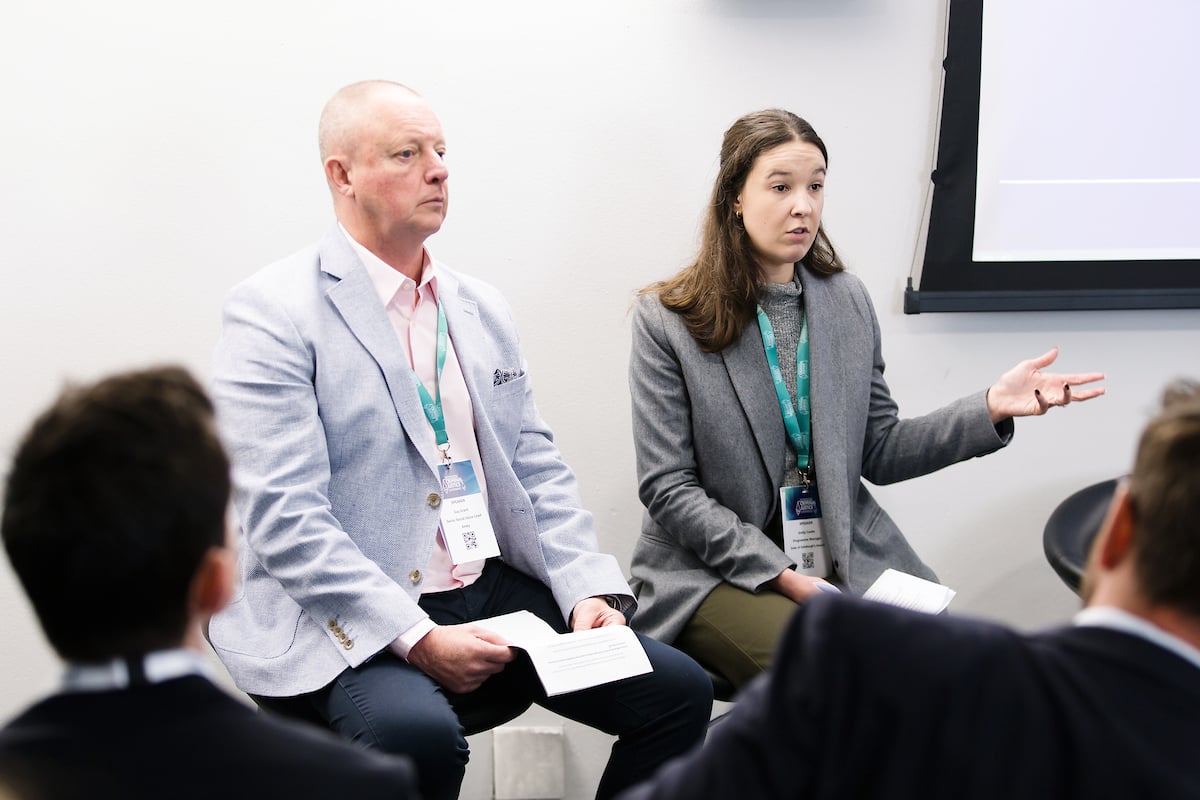
A summary of Caprice Roberts, Guy Grant and Emily Cooke's session at Modernising Criminal Justice 2026.
Caprice Roberts is Senior Social Value Manager at Amey. Guy Grant is Senior Social Value Lead at Amey. Emily Cooke is Programme Manager at the Duke of Edinburgh's Award.
Youth re-offending stands at 31 per cent - higher than adult peers at 28 per cent. A record 1 million young people aged 16 to 25 are not in education, employment, or training. Sixty-five per cent of young people in custody were excluded from school. These facts frame why Amey, the Duke of Edinburgh's Award, and the Ministry of Justice built the Step Ahead Pathway: because young people in the justice system face compounding disadvantage, and traditional approaches aren't closing that gap.
Why Now?
Caprice Roberts, Amey's rehabilitation lead, laid out the landscape. Disrupted education is a key indicator for custodial sentences. Seventy-two per cent of young people in custody received fixed-term exclusions. They didn't learn soft skills - confidence, teamwork, aspiration - in the educational environment because they weren't there. Employers overlook them as immature, not serious candidates.
The immediate jobs crisis is one problem. The deeper problem is that young people don't see a future. Emily Cooke from the Duke of Edinburgh's Award spoke about this clearly: young people leaving school, college, or custody don't automatically perform as employers expect. The onus is on employers to bridge that gap. But it's not just about practical skills. Emily emphasised that soft skills - called essential skills now - are exactly that: essential. You can't work as a team, articulate problems, show resilience if nobody's shown you how or given you space to practice.
What's Different About Step Ahead
Guy Grant explained the structure. Amey delivers facilities management in 64 prisons - qualified tradespeople, plumbers, electricians, ground maintenance staff. Traditionally they do their jobs. But through a programme called CRED (Clean, Rehabilitative, Enabling, Decent), young people work alongside Amey staff, learning practical skills. They're not tutors or instructors - they're role models. A plumber says: you can work with me, gain these skills. Simple.
Step Ahead weaves that together with the Duke of Edinburgh's Award. Young people commit to a six-month programme combining practical work experience with the Award's components: personal challenge, learning new skills, volunteering, physical fitness, mental wellbeing, community connection. At the end, they have not just portfolio evidence but a qualification, a reference, and ideally a real job offer.
Guy and Emily both stressed what makes this different: it's joined up. Traditional prison programmes operate in silos - education does one thing, facilities management does another, the Duke of Edinburgh does something else. Step Ahead connects them explicitly. Education providers link vocational qualifications to the practical skills young people are learning. Amey staff provide the real-world role models. The Duke of Edinburgh Award structures reflection and personal development. It's seamless.
Why Confidence Matters
Emily made a crucial point: you can teach someone to be a plumber. You can't teach someone to be a confident plumber without giving them real experience in a safe environment where mistakes are okay. Young people leaving school at 12, never engaged with work, never had to work as a team in any formal setting - they need to do those things in conditions where failure doesn't destroy their prospects.
The Duke of Edinburgh's Award, across 120 countries, works with 14 to 24-year-olds. That's uncommon. Most youth programmes end at 18. But people grow up unevenly. Some 17-year-olds need that extended support. The Award's research shows that for young people in custody, building self-worth and confidence has massive impact. They don't see a future. They don't see how they fit or what they can contribute. Doing the Award, working with real staff, experiencing real work - that changes the narrative. They visualise a pathway instead of a dead end.
The Real Outcomes
Caprice spoke about measuring success differently. Yes, KPIs matter - getting people into employment. But Amey's learned from working with the Award to measure soft skill performance too. Looking at the whole individual, not just the cohort. Some programmes see engagement tail off. Step Ahead is seeing six-month commitment rates from young people who left school at 12. That's unprecedented.
Post-release, reduced re-offending is the ultimate goal. But the pathway doesn't end at release. Emily noted that the Duke of Edinburgh works beyond custody. Young people who start in prison can continue afterward - volunteering, leadership, development opportunities up to age 25. They don't just do the programme and leave. They build connections to real organisations. Amey has connections with employers offering guaranteed interviews. The support doesn't stop at the gate.
Guy added a practical detail: some young people have nowhere to go after release. No fixed abode, no family support, no safety net. Step Ahead recognises that. Amey works in the community too. The Duke of Edinburgh has community connections. Together they create a support structure that extends past release.
What Industry Needs to Do
Guy was direct: collaborative working is absolutely key. Prisons have many organisations doing good work, but they often operate in isolation. What's needed is asking not just "why are you here" but "what can you bring to the table that solves the problem together?" Amey isn't the only employer. Emily urged employers across sectors to be braver. There's real talent in the justice system. Young people want to work. There's passion and skill there.
Emily pointed something important: this generation of young people care about the world. They want to contribute. Employers sometimes see only the offence, not the person. If you train someone early, invest in them, they're more likely to stay, progress through your organisation. The impact is social - reduced re-offending - but it's also business sense.
Guy mentioned something innovative: Release on Temporary Licence. Instead of traditional unpaid work, Amey created opportunities for serving prisoners to work on-site maintenance, paid appropriately, getting proper recognition. Rethinking what work means, not just for rehabilitation but for dignity.
Expanding the Model
One audience member asked about prevention - reaching young people before custody. Caprice acknowledged this is next. Step Ahead focused on custody because they had successful programmes there. But Amey is building partnerships with community interventions, alternative provision, schools identifying excluded young people. The Duke of Edinburgh is extending into these spaces, adapting programmes for different contexts. It won't be an identical pathway - the employer won't always be facilities management - but the principle holds: early intervention, real work, soft skill development, extended support.
Budget is a real barrier. One educator mentioned education budgets slashed by 50 per cent, no funding for qualifications. Guy works with what's available - education providers they're linked with, vocational qualifications that fit. Amey funds the young people's places. It's not a perfect solution, but it demonstrates commitment beyond contract.
The Deeper Lesson
What emerged was simple: rehabilitation doesn't mean programmes done to young people. It means pathways designed with them. Real work, real people, real consequences, real support. Confidence can't be taught in a classroom. It comes from being trusted with responsibility, making mistakes safely, and being believed in by people who have real-world credibility.
That's what Step Ahead does. And if it works for custody, adapted versions could work for prevention, diversion, community sentences. The principle doesn't change: join the dots, involve young people, give them real experience with real people, and believe they can change.

Jessica Kimbell, GovNet